OwlSheets Students
← Exit

Material Choices at the City Key Shop

0 / 13

Material Choices at the City Key Shop

Compare sample properties to check sorting and design plans.

Compare the Test Records

Read the shop's records. Use the sample letters to follow each material through the checks.

Seven Samples at the Key Shop

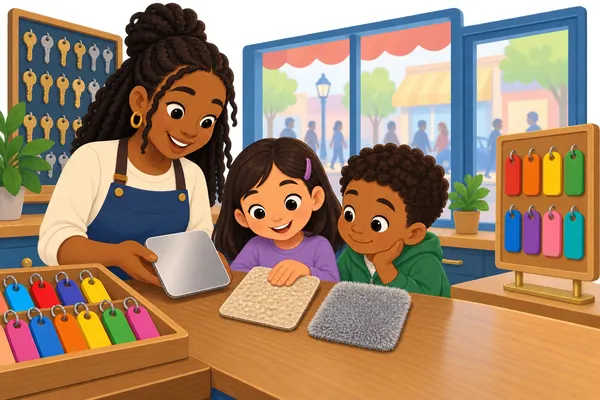
Imani runs a key shop on a busy city street. She is planning tags, curved trim, and padding for a key pickup board. Before choosing materials, she checks seven safe samples with finished edges. She changes the sample but keeps her checks the same. She looks at each color and gently feels each surface. Then she uses the same gentle press and the same gentle bending test. She does not force a sample to bend. She records its color, texture, whether it dents, and whether it bends.

Color check
Purple: A foam sheet, D plastic strip, G fleece piece.
White: B foam sheet, E plastic tile.
Gray: C rubber pad, F plastic tile.

Texture check
Smooth: A, B, D, E.
Bumpy: C, F.
Fuzzy: G.

Press check
Dented (soft): A, B, C, G.
Did not dent (hard): D, E, F.

Bend check
Bent easily: A, B, C, D, G.
Stayed straight: E, F.

1.
Compare foam samples A and B. Which property would put them in different groups?
Question 1 options
2.
Imani wants to compare matching colors for the board. Sort the seven samples by color.
3.
Complete the sorting rules. Use the word bank. Two words will not be used.

To separate pieces by how their surfaces feel, sort by .
To separate pieces by how easily they bend, sort by .

4.
Imani makes a tray for bumpy samples. Circle the two samples that belong.

Check the Material Plans

Use the test records to sort samples and judge which materials meet each plan.

5.
The shop needs separate trays for hard and soft samples. Sort by the press check, not by color or texture.
6.
A curved trim design needs a purple, smooth sample that bends easily but does not dent. Which sample meets these needs?
Question 6 options
7.
Imani makes three design trays. Ignore color and texture. Use the hardness and bending rules on the tray labels.
8.
A new sample arrives. Which plan would let Imani compare its hardness fairly with the tested samples?
Question 8 options
9.
One padding plan calls for a gray, bumpy material that dents under a gentle press. Should Imani choose C or F? Name the sample and use the records to explain why it fits better.

Find Mistakes and Missing Evidence

Check each claim against the records. Think about which property each test shows.

10.
A worker puts the smooth samples A, B, D, and E in a tray labeled “Soft.” Which correction agrees with the press check?
Question 10 options
11.
A worker makes these groups:
Group 1: A, B, C, D, G
Group 2: E, F
Which rule fits the groups?
Question 11 options
12.
Imani records that a new sample is purple, dents, and bends easily. What should she do next to finish checking the four properties?
Question 12 options
13.
A worker says, “This new purple sample will be soft because A is purple and soft.” Is its color enough to decide? Use samples A and D as evidence. Tell what the worker should do next.