OwlSheets Students
← Exit

Words, Music, and Egg Designs

0 / 13

Words, Music, and Egg Designs

Explore three ways people express their cultures.

Read About Three Traditions

Read the passage. Circle the best answer for each question.

Culture Has Many Forms

Culture includes a group's languages, arts, music, and customs. A tradition is a practice people pass along. Across America, people express their cultures in many ways. Here are three examples. They do not describe everything about these groups.

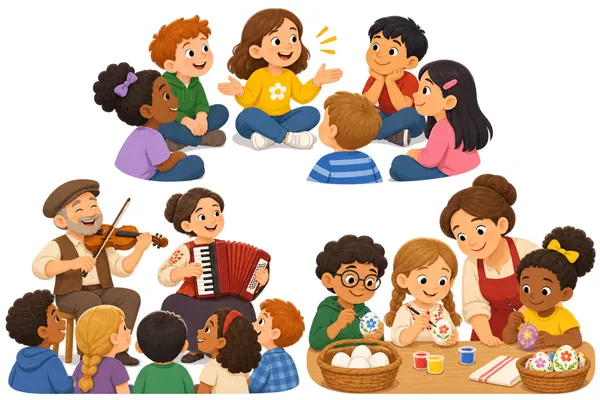
Wampanoag people are Native people whose homelands include parts of Massachusetts and Rhode Island. Wampanoag communities live there today. Some families take part in learning Wôpanâak, their people's language. Teachers and learners use words in games, songs, and everyday talk. Children can practice with other speakers instead of learning words from a page alone.

Many Cajun communities live in Louisiana. Cajun music often includes fiddles and accordions. A fiddle is a violin. An accordion makes music as a player presses buttons or keys and moves its folded middle. Some musicians sing in French. At gatherings, people may play music while others dance. Young musicians can learn tunes by listening to experienced players.

Some Ukrainian American families decorate eggs called pysanky. A maker puts wax on parts of an egg, then adds dye for color. The wax keeps dye off the covered places. Repeating the steps can make colorful patterns. Makers may teach others how to hold the tools and plan designs. Families choose which traditions to practice; people within a group do not all make the same choices.

1.
Why does the passage describe words, instruments, and decorated eggs?
Question 1 options
2.
A child uses Wôpanâak words while playing a game. What is the child practicing?
Question 2 options
3.
Circle the two details that show people learning through hearing other people.

4.
What does the passage show about language and Cajun music?
Question 4 options
5.
Why might a new pysanky maker watch an experienced maker's hands?
Question 5 options
6.
Which sentence corrects the idea that Wampanoag people belong just to the past?
Question 6 options

Use What You Learned

Use the passage to think about each new example.

7.
A Cajun gathering has musicians and dancers. How could someone join in without playing an instrument?
Question 7 options
8.
A new language class gives students word lists but little time to speak. Which addition follows the Wôpanâak example?
Question 8 options
9.
An egg maker wants one part of an egg to stay its first color when more dye is added. Which step from the passage would help?
Question 9 options
10.
Circle the two descriptions that agree with the passage.

11.
A report puts Cajun music under the heading “Native American Traditions.” What correction does the passage support?
Question 11 options
12.
Which pair shows a tradition being passed along, rather than just an object being stored?
Question 12 options
13.
Can practicing with another person help a cultural tradition continue? Give your answer. Use details from two different groups in the passage to explain.