OwlSheets Students
← Exit

A Neighborhood Workshop Connected to the World

0 / 13

A Neighborhood Workshop Connected to the World

Explore why places trade and how one shipment can have two names.

Connections on a City Block

Read about a made-up business in a large US city. Use the passage to answer the questions.

Behind the Eyeglass Shop

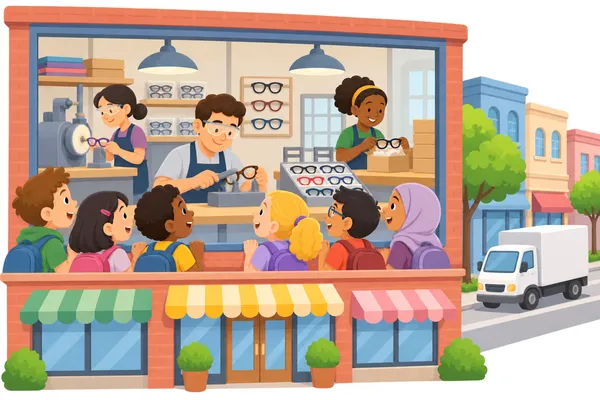
Brickline is a busy neighborhood in a large United States city. Above a row of stores, Clearview Workshop makes eyeglass frames. Workers shape the pieces that hold the lenses. They also make frames in unusual sizes that some customers have trouble finding.

Clearview buys small metal hinges from a business in Italy. The hinges let the arms of the frames fold. The Italian supplier has equipment for making these tiny parts. Clearview has tools for shaping frames, but it does not have equipment for making hinges. Its workers attach the purchased hinges to their frames.

Not every purchase crosses a country's border. A sewing shop across the city makes soft pouches for Clearview's frames. Clearview could sew pouches, but its workers would have less time to make frames. The sewing shop already has suitable machines and workers who know how to use them.

Clearview sells frames to shops in its own city and to a shop in Canada. The Canadian shop orders sizes its usual supplier does not offer. Money from these sales helps Clearview pay its workers and suppliers. Buyers gain more choices, while sellers gain customers beyond their neighborhoods.

Trade means buying, selling, or exchanging goods and services. Goods entering a country from another country are imports. Goods leaving a country for another country are exports. A sale between two US neighborhoods is trade, but it is not an import or export between countries.

1.
Which difference helps explain the trade between Clearview and the Italian hinge supplier?
Question 1 options
2.
Clearview could make its own pouches. Why does buying them from the sewing shop still make sense?
Question 2 options
3.
Circle the TWO details that directly show how buyers benefit from these trades.

4.
A student says, "Clearview sells frames abroad because people in its own city do not buy them." Which correction does the passage support?
Question 4 options

Follow the Shipment

Use these made-up shipping records. Think about which country's border the goods cross.

Clearview's Shipping Records
GoodsSent fromDelivered to
Metal hingesItalyUnited States
Soft pouchesUnited StatesUnited States
Eyeglass framesUnited StatesCanada
5.
Which label belongs on Italy's record for the hinge shipment?
Question 5 options
6.
For the frame shipment, which pair of labels is correct?
Question 6 options
7.
A worker labels the pouch shipment "US import" because it arrives from another neighborhood. What should the worker check?
Question 7 options
8.
Can the same box of goods be both an import and an export? Make a claim. Use one shipment from the records and explain how the two countries would describe it.

Use the Trade Ideas

Apply what you learned to these new situations.

9.
In another city neighborhood, a shop makes large signs. A shop across town makes small labels. Each buys the other's products when needed. What best explains this community trade?
Question 9 options
10.
A grocery store in a cold region buys oranges from a warmer country. Growing oranges nearby would require costly heated buildings. Which reason for trade fits this situation?
Question 10 options
11.
A Canadian business makes cases and sells them to a US store. Circle the TWO facts needed to decide whether the shipment is a US import.

12.
Two communities both make shoes, but they offer different styles. People in each community buy some shoes from the other. What does this example show?
Question 12 options
13.
A student claims, "A business should make everything it uses instead of trading." Use Clearview and the sewing shop as evidence to explain why trading can be useful even when a business could make a good itself.