OwlSheets Students
← Exit

Life Cycle Connections at the Fountain Steps

0 / 13

Life Cycle Connections at the Fountain Steps

Use park records to compare life cycles and build a model.

Investigate the Park Records

Read the passage. Use its evidence to answer the questions.

Three Lives Near a City Park Fountain

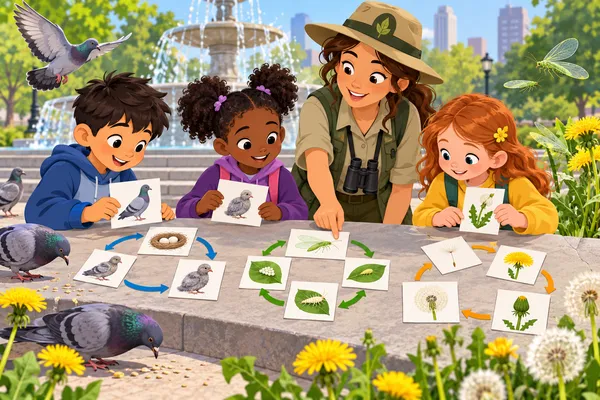
The steps beside a city park fountain are a good place to watch living things. Pigeons nest on a nearby ledge. Lacewings visit the shrubs. Dandelions grow beside the steps. A park naturalist, Ada, collects photographs and notes over several years. Her records follow changes in individual plants and animals.

Scientists use life cycle models to organize changes. Birth means a new life begins; hatching and seed sprouting can represent this beginning in a model. Growth includes getting larger or developing new body parts. Reproduction means producing offspring, or new young. Death ends an individual's life. Not every individual survives to reproduce. Models can show a typical life cycle without claiming that each individual completes it.

Lacewing records: A tiny larva hatches from an egg. The larva eats and grows. Later, it makes a small cocoon and becomes a pupa inside. An adult with wings emerges. Adult lacewings can reproduce and lay eggs. Ada's photographs follow individuals through these changes.

Pigeon records: A chick hatches from an egg. The chick grows and develops feathers. Later, it can fly and grows into an adult. Adult pigeons can reproduce and lay eggs. The records show no cocoon or pupa stage.

Dandelion records: A seed sprouts. The seedling grows more leaves and becomes an adult plant. An adult produces flowers and then seeds. Some seeds sprout into new plants.

Ada also records the deaths of individual lacewings, pigeons, and dandelions. Individuals may live for different lengths of time after reproducing. Adults and their offspring may be alive together. An adult does not shrink back into its own egg or seed.

1.
A visitor thinks a lacewing larva and an adult lacewing are different kinds of animals. Which evidence best helps correct this idea?
Question 1 options
2.
Sort each observation by the life process it shows.
3.
Which comparison would make an accurate label for the lacewing and pigeon models?
Question 3 options
4.
Complete the lacewing model. Use the word bank. One word will not be used.

Egg hatches → larva grows → inside a cocoon → winged

5.
Underline the two statements supported by comparing all three records.

Read and Improve Models

An arrow shows a connection. Decide whether it shows growth, reproduction, or the end of an individual's life.

An unfinished pigeon model
Egg hatches → chick grows and develops feathers → adult pigeon → death
6.
Which addition would show how this pigeon model connects to a new generation?
Question 6 options
7.
Match each arrow in a dandelion model to its meaning.
8.
Sort these model labels. Which describe a process shared by all three life cycles? Which describe a detail found in just one of these three cycles?
9.
Support this claim: “Dandelions and lacewings have different life cycles, but their cycles include the same four life processes.” Name the four shared processes. Then give one dandelion detail and one lacewing detail that show how their cycles differ.

Follow the Next Generation

Use the dated record and the passage to check a claim and build your own model.

A tagged dandelion beside the fountain steps
May 8: Plant A is alive and has a seed head. Ada collects several of its seeds and plants them in a labeled pot.
May 29: Some collected seeds have sprouted. Plant A is still alive beside the steps.
August 14: Ada records that Plant A has died. Several young plants grown from its seeds are still alive.
10.
What does the May 29 record show about generations?
Question 10 options
11.
A student draws “Plant A dies → Plant A turns into the young plants.” Which correction best fits the dated record?
Question 11 options
12.
Ada wants to extend the record to show another connection between generations. Which new observation would provide the best evidence?
Question 12 options
13.
Build a lacewing life cycle model with words, pictures, and arrows. Include an egg, larva, pupa, and adult. Label birth, growth, reproduction, and death. Show which arrow connects to a new generation. Show death as the end of an individual's life, not as a step that changes it into an egg.