OwlSheets Students
← Exit

Beyond the Beam at Gullstone Light

0 / 13

Beyond the Beam at Gullstone Light

Read a speech about the hopes and experiences of an immigrant family.

A Lighthouse Gathering

Read the speech. Use its details to answer the questions. Circle one answer unless a question says otherwise.

This fictional speech is set in 1912 at Gullstone Light, an invented lighthouse on the Massachusetts coast. Celina, an immigrant from Portugal, speaks to visitors. Her account uses historically accurate immigration practices.

Celina's Speech

Thank you for inviting me to Gullstone Light. Ten years ago, when I was twelve, my family left Portugal. Storms had damaged fishing boats near our home. Father repaired boats, but fewer owners could pay him. He heard that coastal towns in the United States needed repair workers. Mother also hoped her children could attend school regularly instead of missing lessons to earn money.

Our ship reached New York Harbor. We waited aboard, then took a smaller boat to Ellis Island. Doctors checked our health. Officials compared our answers about names and destinations with the ship's passenger list. Father needed another medical examination and stayed overnight. We worried because we did not yet know whether he would receive permission to enter. The next day, he was allowed to join us.

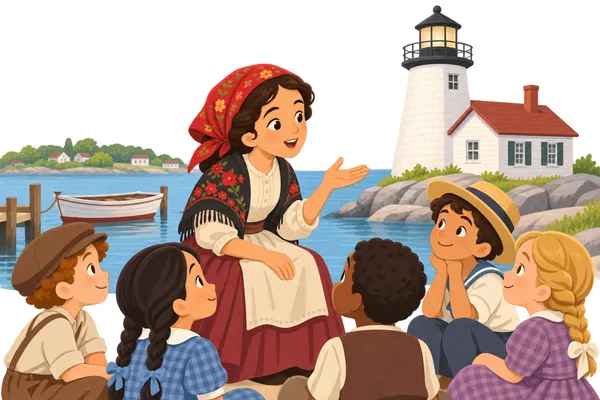
After receiving permission to enter, we traveled onward to Massachusetts. On a local boat, we saw this lighthouse. Its beam helped our boat's captain find a safe course. The lighthouse was not an immigration station; our entry checks had happened in New York.

Father asked at several workplaces before finding a boat-repair job six weeks later. Mother already knew how to sew strong work clothes, though she could not yet read English sewing instructions. A neighbor explained unfamiliar words while Mother showed her a useful sewing method.

At school, I understood numbers before I understood many English sentences. For months, I practiced reading weather notices with a classmate. Eventually, I could read them myself. When visitors admire this light, I remember more than our boat reaching shore. I remember the hopes we carried, the waiting, and the work of learning a new place.

1.
Which explanation best connects the family's life in Portugal with its decision to immigrate?
Question 1 options
2.
What does Father's search after reaching Massachusetts show about the work he had heard about?
Question 2 options
3.
Circle TWO details that show the family spent time waiting during the arrival process.

4.
A visitor says, “Father's extra examination meant he had been refused entry.” Which correction does the speech support?
Question 4 options
5.
Which pair of exhibit labels would correctly explain the two places in Celina's journey?
Question 5 options
6.
Circle ONE detail that is evidence that learning English and already having useful skills could happen at the same time.

7.
What does Celina's experience with weather notices help explain about attending school in a new country?
Question 7 options

Use the Evidence

Read the history note. Apply what you learned to the new examples, then write an answer supported by the speech.

History note: Immigrating means moving from one country to settle in another. People came to the United States for many reasons, including work, schooling, family, and freedom from unfair treatment. Ellis Island handled many arrivals, but immigrants also entered through other ports and land borders.
8.
In a new fictional account, Ewa's parents have steady jobs. They move to the United States because their daughter has few chances to attend school where they live. Which part of Celina's account most closely matches their reason?
Question 8 options
9.
Which new example describes immigration rather than a visit or a move within one country?
Question 9 options
10.
A new fictional arrival says, “The official asked my name. That proves the official was giving me a new one.” Which explanation from Celina's experience is better supported?
Question 10 options
11.
In another fictional account, Anton's family has enough work, but local rules treat them unfairly because of their religion. They immigrate to seek greater freedom. How does their reason compare with Celina's family's reasons?
Question 11 options
12.
An exhibit writer proposes this sentence: “Immigrants to the United States followed Celina's route through Ellis Island.” Which revision best uses both the speech and the history note?
Question 12 options
13.
A child at the lighthouse asks Celina, “If moving meant waiting and extra checks, why did your family come?” Explain why the family might have thought the move was worthwhile. Use both reasons for moving and at least one arrival experience from the speech.