OwlSheets Students
← Exit

A Weaving Plan for the History Museum

0 / 14

A Weaving Plan for the History Museum

Help a class check how a business produces its work and sets prices.

Study the class plan

Read the planning record. Use it to think about the work behind each offering.

Two Offers for One Class

Ms. Velez's class is planning a visit to Millstrand History Museum. Twelve students want to learn about handweaving. At their planning meeting, they examine two offers from Nerina's Weaving, a made-up business that works in the museum's craft room.

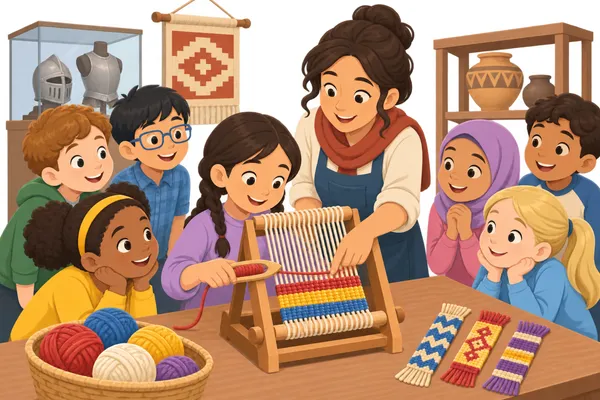
For $60, Nerina will supply an order of twelve finished woven bookmarks. She measures and cuts yarn, stretches threads on small weaving frames called looms, and weaves more yarn through them. She ties the ends and checks each bookmark before packing the order. The class receives finished goods.

For $72, Nerina will lead one weaving lesson for all twelve students. Before they arrive, she winds yarn into small bundles and tests the looms. During the lesson, she shows the steps, watches students practice, and helps them fix loose threads. Each student makes a bookmark to take home. Nerina supplies yarn and equipment, but she does not provide already-finished bookmarks for this offer.

Nerina gives the class a cost record. Worker time is a business expense, including time spent preparing before customers arrive. The equipment and room amounts are each offering's share of those expenses. The table includes all estimated costs for each whole class order or lesson. These are business expenses, not prices paid by customers. The class has not placed an order. Students agree to examine the work and the costs before choosing together.

1.
A helper has cut the yarn for the finished-bookmark order. Which plan would complete the goods the class ordered?
Question 1 options
2.
Both offers let students take home bookmarks. Why is the lesson still a service?
Question 2 options
3.
A new helper skips testing the looms before a lesson. Two looms have loose parts. What problem would most likely follow?
Question 3 options
4.
Circle the TWO work details that are evidence that producing the lesson takes worker time before students arrive.

Check the costs

Use the table and the planning record. Each column is for one whole order or one whole lesson for twelve students.

Nerina's Estimated Business Costs
Expense12 finished bookmarksOne class lesson
Yarn and supplies$12$12
Making bookmarks$24$0
Preparing lesson$0$12
Teaching lesson$0$24
Equipment and room$12$12
5.
A student adds $12 + $24 and records $36 as the full cost of the finished-bookmark order. What needs correcting?
Question 5 options
6.
Nerina considers a special lesson price that would cover the lesson's full estimated cost and leave $6 after those expenses.

The price for the whole lesson would be $.

7.
Compare the usual prices in the planning record with the full costs in the table. Which statement is correct?
Question 7 options
8.
Suppose Nerina charges $5 per student for the twelve-student lesson instead of her usual group price. What would the class's total payment do?
Question 8 options
9.
A different group has six students. Its yarn and supplies cost $6. Preparing, teaching, equipment, and room costs stay the same as in the table. Nerina considers charging each student $7. What would happen?
Question 9 options
10.
Another twelve-student class offers to bring suitable yarn and supplies. This removes the lesson's $12 supply expense, but checking their materials adds $6 in worker time. Other costs stay the same. What is the new full lesson cost?
Question 10 options
11.
The class requests twelve wider finished bookmarks. Yarn and supplies would cost $24 instead of $12. Making the bookmarks and using the equipment and room would cost the same as before. Would the usual $60 order price cover this new cost?
Question 11 options
12.
Which comparison from the table best explains why the usual lesson costs Nerina more to produce than the usual finished-bookmark order?
Question 12 options

Explain a decision

Make a claim and support it with work details and cost calculations.

13.
The class agrees on two goals: students should practice weaving with help, and their payment should leave Nerina at least $10 after estimated costs. Which usual offer meets both goals? Explain using a work detail, the price, and the full cost.
14.
A new museum business plans a guided listening session about the town's history. A worker will prepare recordings, test headphones, and help visitors use them. For one session, preparation and helping visitors cost $18, equipment use costs $6, and room use costs $6. The owner is considering a group price of $28 or $34. Which price covers the full cost? Explain your calculation and why this service has production costs even though visitors do not buy an object.